
 EN
EN  ES
ES 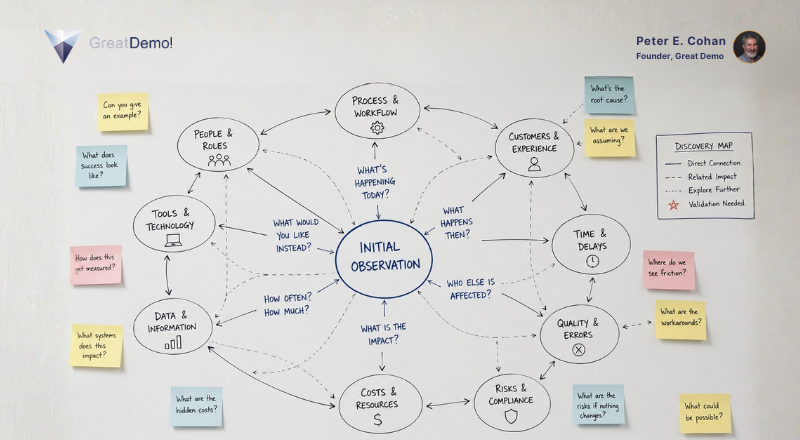
Your prospect admits, “It’s a manual process.”
You reply, “Does it typically go smoothly? What happens when someone is on vacation?”
“It’s a mess! We literally have tickets piling up on people’s desks…!” divulges your prospect.
Congratulations! You’ve just deepened and broadened your prospect’s pain using the essential discovery skill of Expansion Questions. So, what are they, how do you use them, and when?
Expansion Questions are a series of interrelated questions designed to span five of the seven discovery skills levels, from uncovering pain to reengineering vision. They are a simple, yet essential skill to master in doing discovery enabling you to extend, deepen, and quantify your prospects’ pains and related impacted areas.
Expansion Questions leverage your experiences with other prospects and customers, providing you with lists of likely problem areas, impacts, and outcomes to explore with new prospects.
An Example
Let’s return to the conversation above. A skilled vendor and their prospect are talking about the prospect’s current workflow that handles customer requests and issues. Let’s listen:
Prospect comments, “It’s a manual process…”
Vendor responds, “Sorry to hear this – what takes place today?”
Prospect explains, “Well, each request is entered, reviewed, processed, escalated, and closed in a series of steps, with each step done manually by an individual, then passed to the next person in line.”
The vendor asks an Expansion Question, “Does it typically go smoothly? For example, what happens when someone is on vacation?”
The vendor knows, based on previous experience with similar prospects, that vacations often have serious negative impact on these workflows.
Prospect replies, “It’s a mess! We literally have tickets piling up on people’s desks…!”
Vendor responds, “What happens then?”
Prospect offers, “At minimum, it causes delays in response time which impacts customer satisfaction.”
Our vendor makes a note to come back to this impact statement later, but focuses on the current issue for now:
Vendor asks, “I see… How many folks are involved on your team?”
Prospect says, “We have a total of 12 people doing this, and it is far too many!”
Vendor pursues, “Understood. And what would you like to reduce this to?”
Prospect states, “I’d love to get this down to two people. There’s plenty on the team’s plate that needs to be done in addition to this process!”
Note that our vendor has quantified a desired outcome – a Delta – reducing the number of people in the workflow from twelve to two. Next, knowing that manual processes typically result in errors, our vendor introduces another Expansion Question:
Vendor queries, “I see – how often do errors creep into your process today?”
Prospect declares, “Oh, all the time…!”
Vendor expands, “And what happens when errors occur?”
Prospect admits, “Well, we often have to go back, find the error, and then rework the downstream portion of the workflow. It can get pretty bad!”
Vendor quantifies, “Sorry to hear this – how often does this occur and how long does it take to correct, on average, for each occurrence?”
Prospect notes, “At least once a week and it can consume hours to fix each one.”
Vendor offers, “And I’m guessing you’d like to reduce this to zero or near zero, if possible. Is that correct?”
Prospect responds, “Absolutely…!”
Note that our vendor has now quantified two aspects of the manual process, so far, capturing the prospect’s specific numbers. Our vendor then explores more impact through another Expansion Question, again based on experience with other prospects:
Vendor asks, “And what happens downstream? Who else is impacted?”
Prospect notes, “Oh, it ripples throughout the organization, resulting in sending the wrong patches, incorrect documentation for customer success managers, mistakes with our product roadmaps, inaccurate renewals forecasts, and the worst cases can result in very unhappy customers, which we know contributes to churn!”
Vendor asks, gently, “Do you get grief from these other teams, as a result?”
Prospect admits, “Yes, it’s added a lot more pressure to fixing this problem…”
Vendor confirms and moves towards a discussion of solutions:
Vendor resumes, “I see. So, this is really impacting the organization broadly. Let’s change gears back to your current manual process: are you looking to automate this following the existing workflow or do you have any other changes in mind?”
Prospect says, “The individual steps are all fine, we just need to get rid of the manual work and physical hand-offs.”
Our vendor realizes that the prospect is unaware of the range of possible solutions and expands using a Biased Question to explore Vision Reengineering with the prospect:
Vendor notes, “Interestingly, many of the other companies we’ve worked with found that the ability to both automate their workflows and implement AI rules-based processing and alerts not only eliminated the errors and handoffs but also resulted in dramatically reduced churn and increased renewals. Some of our customers report 10-20% less churn and 5-10% increases in renewals and add-on sales. Is an AI rules engine something that might also be useful in your practice?”
Prospect responds, “Wow, I hadn’t thought about that. Yes, that would be really cool! How does that work?”
We’ll leave the conversation at this point and let our vendor and prospect continue on their own…
Are You Leading the Witness?
Yes, absolutely…!
Expansion questions take advantage of your knowledge about other, similar prospects’ situations. Any time you know, from your experience, that another aspect of your prospect’s pain is likely, that’s a candidate for an Expansion Question.
Here are a few logical examples:
- Manual processes: are likely to have errors which propagate and associated delays which probably impact others.
- Paper processes: are subject to similar issues, plus lost papers and transcription errors (what do these impact?).
- Email communications: may suffer from lost or ignored messages and vague assignments (what happens then?).
- False positives or false negatives: can represent a world of pain on their own!
- Poor CRM hygiene: results in false forecasts, pipeline uncertainty, and scrambling customer success managers.
- Inaccurate documentation: can yield substantial rework, delayed invoicing, unhappy customers, and more.
Expanding to Level 5 of Discovery
In the brief example above, our vendor moved the prospect gently (but firmly!) through five levels of discovery, using Expansion Questions to drive the process:
Level 1: Uncovers statements of pain:
– Manual process.
Level 2: Explores more deeply:
– [Expansion Question] Vacations?
Level 3: Broadens the pain and investigates the impact:
– [Expansion Questions] Errors? Downstream impact?
Level 4: Quantifies:
– Reduce from 12 people to 2; eliminate weekly errors that take hours to fix.
Level 5: Reengineers vision:
– Introduces the AI rules engine using a Biased Question.
Expansion Questions, along with Biased Questions and related probing techniques, are fundamental discovery skills and are key components of a cohesive, integrated discovery methodology.
Four Stages and Discovery
The classic set of Four Stages of Competence is particularly apropos for doing discovery:
Stage 1 – Unconsciously Incompetent:
They don’t know what they don’t know. Many (most?) sales and presales folks are in this category but are unaware…!
Stage 2 – Consciously Incompetent:
They understand that they need to do better or operate differently, but don’t know what or how to accomplish this.
Stage 3 – Consciously Competent:
They know what to do but have to consciously think to execute properly.
Stage 4 – Unconsciously Competent:
They do the right things without extra thought.
For example, are you aware of and apply the following skills?
- Ranging Probes
- Biased Questions
- Provocative Questions
- Empathy and Quid Pro Quo
- Vision Reengineering
- The Curse of Knowledge
- Wants vs Needs
- “Why?” Questions
- Avoiding “No Decision”
Where are you and your team on the competency spectrum?
Resources in Doing Discovery:
Expansion Questions – page 173
Ranging Probes – page 172
Biased Questions – page 183
Provocative Questions – page 253
Empathy and Quid Pro Quo – page 199
Vision Reengineering – page 217
The Curse of Knowledge – page 274
Wants vs Needs – page 164
“Why?” Questions – page 180
Avoiding “No Decision” – page 234
Resources in Suspending Disbelief: A Collection of Sales, Presales, and Marketing Stories (and Lessons Learned)
The Credit Card Story – page 7
“But You Already Know Their Workflow” – page 9
“You Know You Already Closed Me” – page 19
Who Is Mr. Big Ears? – page 53
“Let Me Close My Door” – page 59
The Million Dollar Demo and the Good Little Salesperson – page 74
A Prospect’s Tale – page 90
Copyright © 2021-2026 The Second Derivative – All Rights Reserved.
.